
For decades, industrial automation has been defined by proprietary silos. Industrial enterprise leaders have spent millions on Programmable Logic Controllers (PLCs), Supervisory Control and Data Acquisition (SCADA) software, and Human-Machine Interfaces (HMIs) wrapped in complex licensing tiers.
Every added data point, expanded tags, additional client node, or CPU core upgrade historically triggered recurring licensing fees. Worse yet, custom integrations were often blocked by closed, vendor-proprietary protocols.
Today, a shift toward open-source industrial architecture is breaking these barriers. By combining Industrial Shields open-source industrial hardware with SCADA-LTS™ (Long-Term Sustainable) supervisor software, manufacturing plants and process facilities can build robust control architecture—unlocked from vendor licensing traps.
1. The Bottleneck: Proprietary Licensing vs. Scalability
Traditional automation vendors lock facilities into rigid software and hardware ecosystems. Expanding an operational plant typically entails:
- Per-Tag Licensing Costs: Scaled costs based on the number of monitored tags or inputs/outputs (I/O).
- Per-User Restrictions: Additional seat fees for concurrent operators on web, mobile, or desktop HMIs.
- Hardware Lock-In: Proprietary PLCs running closed environments that prevent low-level customization or modern IoT integrations.
To scale smart infrastructure and implement Industry 4.0/5.0 concepts, facilities require an architecture where data moves freely from the shop floor to the cloud without artificial cost gates.
2. Field-Level Freedom: Industrial Shields PLCs
Industrial Shields bridges the gap between commercial open-source hardware (such as Arduino, Raspberry Pi, and ESP32) and industrial reliability.
Instead of relying on delicate prototype boards, Industrial Shields packages open-source microcontrollers into DIN rail-mountable, CE-certified, opto-isolated industrial PLCs equipped with robust I/O handling.
Key Hardware Capabilities:
- Protocol Diversity: Native support for Modbus RTU/TCP, RS-485, RS-232, CAN bus, Ethernet, and MQTT.
- Flexibility & Interoperability: Programmable via standard open tools like the Arduino IDE, Python, or Node-RED, allowing engineers to implement custom logic and REST APIs directly at the field layer.
- Zero Firmware Lock-In: Full visibility and access down to the bare-metal firmware level.
3. Supervision Without Boundaries: SCADA-LTS™
At the supervisory layer, SCADA-LTS™ by Abil’I.T. serves as the open-source control system that unifies field data. Distributed under the GPL v2.0 license, SCADA-LTS eliminates license limitations entirely:
- Unlimited Scale: Zero fees for additional DataPoints, DataSources, Screens, Historian Tags, or server instances.
- Unlimited Users: Deploy browser-based operator dashboards across desktops, tablets, mobile devices, or wall-mounted control room displays with no per-seat charges.
- Broad Protocol Support: Native connectivity for OPC UA, MQTT, Modbus TCP/Serial, BACnet/IP, DNP3, SNMP, and custom user-defined scripts via Meta Data Points.
- Deployment Choice: Runs natively on Linux (Debian, Ubuntu, Red-Hat, SuSE), Windows, or as containerized microservices via Docker.
4. Architectural Synergy: Edge-to-Enterprise Integration
Combining Industrial Shields PLCs with SCADA-LTS creates a flexible, end-to-end automation stack:
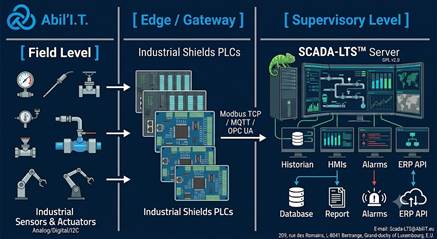
- Field Control: An Industrial Shields PLC reads physical sensors (temperature, flow, pressure) and executes local relay logic.
- Edge Communication: The controller packages field signals into standardized Modbus TCP packets or pushes MQTT payloads over local Ethernet.
- Supervisory Analytics: SCADA-LTS ingests these streams in real-time, handling historical logging, threshold alarms, event-driven workflows, and HMI visual dashboards.
- Northbound Integration: Data is exposed to higher-tier MES or ERP systems via open REST APIs and database connectors without requiring proprietary middleware.
5. Strategic Benefits for Industrial Leaders
Transitioning to an open-source hardware/software architecture provides core operational benefits:
- Predictable Capital Expenditure: Eliminates recurring software license audits and vendor maintenance fees.
- Long-Term System Sovereignty: Full ownership of operational source code and configurations ensures system longevity independent of a single vendor’s product lifecycle.
- Enhanced Cyber Resilience: Transparent “white-box” code allows internal security teams to perform deep vulnerability audits and deploy custom patches.
- Faster Time-to-Market: Engineers can prototype on open hardware platforms and transition directly into production environments using the same codebase.
Conclusion
The combination of Industrial Shields open hardware PLCs and SCADA-LTS™ supervisory software offers a production-ready blueprint for next-generation automation. By removing artificial software paywalls and locked vendor protocols, industrial organizations gain complete sovereignty over their automation infrastructure—paving the way for a more sustainable, adaptable, and cost-effective operational future.


Leave a Reply